Port Talbot's position on the South Wales coast means homes here are no strangers to strong winds and heavy rain rolling in off the sea, and certain parts of a roof tend to bear the brunt of it far more than others when a storm hits. Knowing where to look after a bad night of weather can help you catch damage before it turns into something more serious.
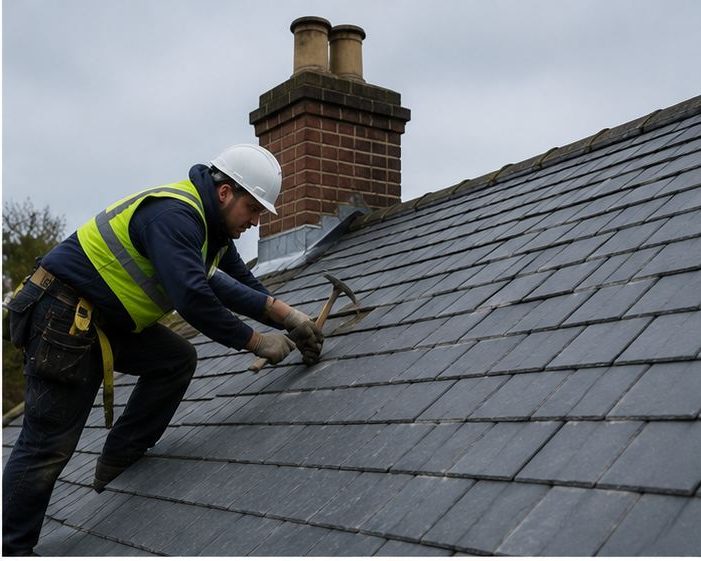
Ridge and hip tiles, sitting along the very top of the roof, are among the most exposed points and are often the first to loosen or dislodge during high winds, since they sit directly in the path of gusts sweeping over the roofline. Once a ridge tile shifts, it can expose the roof structure beneath to driving rain, so these are always worth checking after any particularly severe spell of weather, especially if the wind has been gusting from an unusual direction.
Flashing around chimney stacks and valleys is similarly vulnerable, as strong winds can work at the edges of flashing over time, gradually lifting or loosening it until it no longer forms a watertight seal. Chimney stacks themselves take a battering too, with pointing and rendering sometimes affected by prolonged exposure to wind-driven rain, particularly on older properties across South Wales that have weathered many decades of coastal storms.
Guttering and downpipes can suffer during storms as well, whether from debris blown into them, brackets being wrenched loose by wind, or sheer volume of water overwhelming a system that was already partially blocked. Fascias and soffits, which support and box in the guttering, can also come under strain if fixings work loose during sustained buffeting, sometimes leaving a section hanging or rattling in the wind. None of these components are designed to take that kind of repeated battering indefinitely, which is why storm damage tends to accumulate gradually across several bad spells of weather rather than appearing all at once.
Loose or missing tiles and slates are perhaps the most obvious storm casualty, and even a small number of displaced tiles can leave the roof underlay exposed to rain until they are replaced. It is worth having a visual check done, from ground level, after any significant storm passes through South Wales, looking out for anything obviously out of place, debris in the garden that might have come off the roof, or new staining appearing on ceilings inside. Underlay itself, sitting beneath the visible roof covering, can also be affected if it has been exposed by missing tiles for any length of time, since it is only ever designed as a secondary barrier and is not built to withstand direct weather on its own. Older, more brittle underlay is particularly at risk once it loses the protection of the tiles above it.
If a recent storm has left you wondering whether your roof has taken any damage, T & T Roofing South Wales offers free inspections across Port Talbot and the wider South Wales area to check things over properly and give you an honest picture of what, if anything, needs attention.
Need a Roofer in South Wales?
Every roof is different — the fastest way to get an accurate answer is a quick chat with our team.